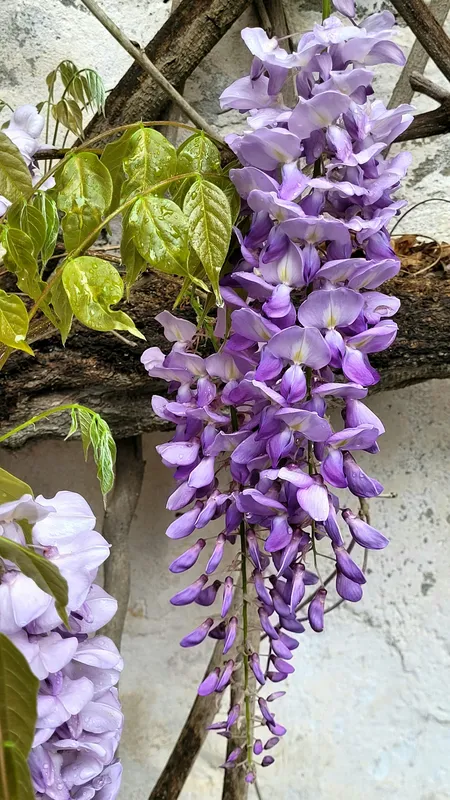
Wisteria (Zi Teng) - The Falling Purple Rain of My Childhood
Every April, when those first warm days hit New York and the whole city exhales at once, I start looking up. Not at the skyline. At the pergolas in the parks, the iron trellises on brownstones, the random arbors tucked behind restaurants in the Village. I am looking for wisteria.
Because for about two weeks every spring, wisteria does something no other plant does. It turns the air purple. Long clusters of violet-blue flowers hang down like a living curtain, swaying slightly in the breeze, filling every corner of your lungs with this grape-sweet fragrance that stops you in your tracks. If you have ever walked through a wisteria tunnel in full bloom, you know exactly what I mean. It is one of those experiences that rewires your brain a little.
For me, though, wisteria is not just beautiful. It is my grandfather.
The Arbor in Flushing
My grandfather - my ye ye - came to Queens from Zhejiang province in 1982. He was a quiet man who spoke almost no English his entire life, which meant he communicated through the things he grew. His apartment had a small concrete patio out back, maybe ten feet by twelve feet, and he turned that space into something that felt like a different country.
There were bitter melon vines climbing a chain-link fence. Bok choy in plastic bins. Chrysanthemums in coffee cans. But the centerpiece, the thing he spent the most time on, was a Chinese wisteria (Wisteria sinensis) that he had trained over a homemade wooden arbor he built from lumber scraps. He called it zi teng - purple vine.
I do not know where he got the original plant. I suspect he grew it from a cutting someone gave him, because that is how things worked in his circle. You admired a neighbor’s plant, and a week later a clipping showed up wrapped in damp newspaper. No money changed hands. Just plants moving between people who understood each other.
By the time I was old enough to remember, that wisteria was massive. Every spring it exploded into these cascading purple flower clusters that made the whole patio feel like a scene from a Chinese painting. My grandmother would set up a folding table underneath it and we would eat lunch in what felt like a purple rain shower. Petals in our hair, petals in our rice, petals everywhere.
My ye ye would sit there with his tea, watching us eat, not saying much. Just smiling. The wisteria said everything he could not say in English.
Why Wisteria Matters in Chinese Culture
Wisteria is not just another pretty vine in Chinese tradition. It carries real weight.
The Chinese name zi teng literally means “purple vine,” but the symbolism runs much deeper. In traditional Chinese art, wisteria represents immortality and longevity. Those twisting, gnarled trunks that thicken over decades embody endurance. A wisteria that has been growing for fifty years looks like it has stories to tell, and in Chinese philosophy, that is exactly the point. The plant represents the continuous flow of life and the interconnectedness of all things.
Wisteria also shows up frequently in Chinese paintings and calligraphy, often alongside bees and butterflies, symbolizing abundance and a life well-lived. In feng shui, practitioners use wisteria as a source of encouragement during moments of doubt - a reminder that beauty takes time but is always worth the wait.
There is also a romantic dimension. In Chinese folklore, wisteria is associated with love and devotion. The way the vine wraps around its support structure, inseparable once established, mirrors the idea of two lives growing together. My grandmother used to joke that ye ye’s wisteria was more devoted to that arbor than he was to her, which always made him laugh.
The concept of yin and yang runs through the plant’s symbolism too. Those hanging flower clusters represent the balance between heaven and earth, strength and gentleness. The trunk is impossibly strong and twisted - pure yang energy - while the flowers are soft, fragrant, and ephemeral - pure yin. Together, they make something complete.
What You Need to Know Before Growing Wisteria
Here is where I have to be honest with you. Wisteria is not a beginner plant. It is not going to kill you, but it demands patience in a way that most houseplants do not. If you are used to the instant gratification of propagating pothos in water, wisteria is going to test you.
It Takes Years to Bloom
This is the big one. A wisteria grown from seed can take ten to fifteen years to produce its first flowers. Even plants grown from cuttings or grafted stock can take three to five years. My grandfather’s wisteria did not bloom its first spring, or its second, or its third. He just kept caring for it. When it finally bloomed, my grandmother said he called three different relatives to come see it that same afternoon.
If you want blooms sooner, buy a grafted plant from a nursery. Look for one that is already flowering, because that tells you it is mature enough to bloom reliably. Wisteria frutescens ‘Amethyst Falls’ is a great container variety that blooms at a younger age than Chinese wisteria.
Sunlight Is Non-Negotiable
Wisteria needs at least six to eight hours of direct sunlight daily. No exceptions. If your apartment faces north and your only outdoor space is a shaded fire escape, this is not your plant. Insufficient light is the number one reason container wisteria refuses to bloom.
South-facing balconies, rooftop gardens, and sunny patios are ideal. If you have a spot that bakes in summer sun, even better. Wisteria loves heat.
It Needs Winter Cold
This surprises some people, but wisteria needs a period of winter dormancy to trigger spring blooms. It is hardy in USDA zones 5 through 9, which means it handles New York winters just fine. In fact, the cold is part of the deal. Without enough chill hours, the plant will not set flower buds properly.
If you live somewhere that never gets below 40 degrees Fahrenheit, wisteria may not be your best bet. It needs that seasonal rhythm of cold and warm to do its thing.
Growing Wisteria in Containers - Yes, It Is Possible
My grandfather had the luxury of planting directly in the ground. Most of us in apartments do not. The good news is that wisteria grows surprisingly well in large containers, and keeping it in a pot actually helps control its famously aggressive growth habit.
Choosing Your Container
Go big. Minimum 18 inches in diameter and depth, but honestly, bigger is better. A half-whiskey barrel or a large ceramic planter works great. Make sure it has drainage holes - wisteria will not tolerate soggy roots.
The container also needs to be heavy or weighted, because a mature wisteria in full leaf acts like a sail in the wind. A lightweight plastic pot will tip over. Ask me how I know.
Soil Mix
Use a well-draining potting mix amended with perlite or grit for extra drainage. Wisteria prefers slightly acidic to neutral soil, around pH 6.0 to 7.0. Mix in some compost for nutrition, but do not go overboard with rich soil. Here is one of those counterintuitive wisteria facts: slightly lean soil actually encourages more blooms. Too much nitrogen and you get all leaves, no flowers.
Watering
During the growing season (spring through fall), water deeply and regularly. Let the top inch or two of soil dry out between waterings. Containers dry out faster than ground plantings, especially in summer, so check often. In winter, reduce watering significantly but do not let the root ball dry out completely.
Feeding
Feed monthly during spring and summer with a balanced organic fertilizer. In late summer, switch to a high-potassium feed (like a tomato fertilizer) to encourage flower bud formation for next spring. Stop feeding in fall.
Here is a common mistake: people load up wisteria with high-nitrogen fertilizer and wonder why they get tons of leaves but no flowers. Wisteria that is too well-fed gets lazy. It thinks, why bother blooming when life is this comfortable? A little stress, nutritionally speaking, pushes it to reproduce.
Pruning - The Most Important Part
Pruning is where most people mess up with wisteria, and it is also the single most important thing you can do to get blooms.
Prune twice a year. In summer, about two months after flowering, cut back the long whippy shoots to five or six leaves from the main branch. This redirects the plant’s energy from growing longer vines to forming flower buds. In winter, when the plant is dormant and you can see the structure clearly, cut those same shoots back further to two or three buds.
It sounds aggressive. It is. Wisteria responds to hard pruning the way my kids respond to a firm bedtime - initially resistant, ultimately better for it.
Support Structure
Even in a container, wisteria needs something to climb or be trained on. A sturdy trellis, an obelisk, or a small arbor works well. You can also train wisteria as a standard (a tree-form shape) by supporting a single main stem with a stake and letting the top branch out. This looks stunning on a balcony.
Whatever you use, make sure it is strong. Wisteria vines become woody and thick over time, and they can bend or break flimsy supports. My grandfather’s homemade arbor was overbuilt on purpose. He used to say building something too strong is never a waste. I think about that advice constantly, and not just when it comes to gardening.
Repotting and Long-Term Care
Repot your container wisteria every two to three years in early spring, before new growth starts. Move up one pot size and refresh the soil. Once the plant is in its largest practical container, you can top-dress instead - remove the top few inches of soil and replace with fresh compost.
Wisteria is a long-lived plant. In the wild, specimens can survive for over a hundred years. Even in a container, a well-maintained wisteria can thrive for decades. This is not a plant you buy for one season. It is a commitment, and honestly, that is part of its appeal.
The Arbor Is Gone, But the Memory Stays
My grandfather passed away in 2019. The apartment changed hands, and I do not know what happened to his patio garden. Someone probably cleared it all out. The wisteria, the bitter melon, the bok choy - all of it likely gone.
But last spring, I bought a small grafted Wisteria sinensis from a nursery in Long Island. It is in a large ceramic pot on my patio, trained on a wooden obelisk that I built myself. It did not bloom this year. It probably will not bloom next year either. That is fine.
My daughter, who is four, helps me water it. She calls it the “purple tree” even though it has never been purple in her lifetime. She just trusts that it will be, because I told her so. And when it finally blooms, I am going to set up a folding table underneath it, and we are going to eat lunch under falling purple petals, and I am going to sit there with my tea and smile and not say much.
Some things you inherit. Some things you rebuild. Either way, the wisteria knows what to do. You just have to give it time.
Getting Started
If wisteria is calling to you, here is your game plan. For containers, look for Wisteria frutescens ‘Amethyst Falls,’ which is more compact, less aggressive, and blooms earlier than Chinese wisteria. If you have ground to plant in and want the full dramatic experience, go with Wisteria sinensis for those classic cascading purple racemes.
Find the sunniest spot you have. Get a big, heavy pot. Be patient. Prune twice a year. And maybe build something a little too strong for it to climb on.
Your future self, sitting under those flowers with a cup of tea, will thank you.