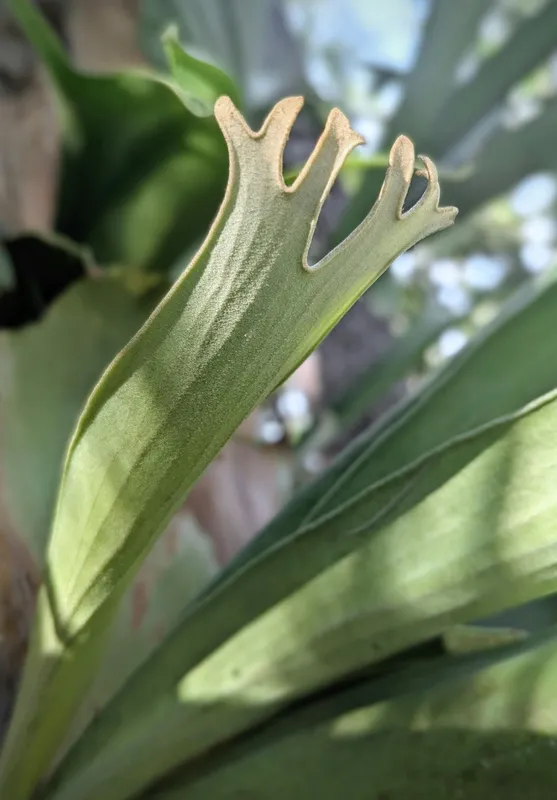
The first time I saw a staghorn fern mounted on a board in someone’s living room, I thought it was fake. There is no way a real plant looks like that, right? Those dramatic, antler-shaped fronds jutting out from the wall like a piece of living sculpture? It felt like something you would see in a fancy plant shop with a $200 price tag and a vibe that says “you are not ready for this.”
But here is the thing - staghorn ferns (Platycerium bifurcatum) are way more forgiving than they look. They have been growing on tree trunks in Australian and Southeast Asian rainforests for millions of years. If they can survive clinging to a tree in the wild, they can handle your apartment wall.
My dad never grew staghorn ferns. His plant collection was firmly in the “practical things we can eat” category. But when I brought one home and mounted it above the bookshelf, even he had to admit it looked pretty cool. “Like deer antlers,” he said, which - yeah, that is literally what the name means, Dad.
What Makes Staghorn Ferns Different
Before we get into the care details, it helps to understand what makes these ferns unique. Staghorn ferns are epiphytes, meaning they grow on other plants (usually trees) rather than in soil. They are not parasites - they just use the tree for support while pulling moisture and nutrients from the air and whatever organic debris collects around their roots.
This is why you will often see them mounted on wooden boards or tucked into hanging baskets rather than sitting in a regular pot. They do not need soil. In fact, keeping them in traditional potting soil is one of the fastest ways to kill them.
Staghorn ferns have two types of fronds, and understanding both is key to not accidentally hurting your plant:
Fertile fronds are the big, dramatic, antler-shaped ones that everyone notices. These are the showstoppers. On a mature plant, they can reach two to three feet long. You will notice they have a slightly fuzzy, silvery coating - do not wipe this off. Those tiny scales (called trichomes) help the plant absorb water and protect it from too much sun.
Shield fronds (also called basal fronds) are the flat, round ones that grow against the mounting surface. These start out green but eventually turn brown and papery. This is completely normal and not a sign of trouble. Do not remove them, even when they look dead. They serve as both an anchor and a nutrient source as they decompose.
Light
Staghorn ferns want bright, indirect light. Think of their natural habitat - they grow in the canopy of tropical forests where they get dappled sunlight filtering through the trees above them.
An east-facing window is ideal. A west-facing window works too, but you might want to filter the afternoon sun with a sheer curtain during summer. North-facing windows are usually too dim, and direct south-facing sun will scorch those beautiful fronds.
If you are mounting yours on a wall, pick a spot that gets consistent ambient light rather than a dark hallway or an interior wall far from windows. They can tolerate lower light for a while, but the fronds will grow slowly and look less impressive.
One thing I have noticed with mine - it leans toward the light source over time. Every few months I rotate the board (easy when it is just hanging on a nail) to keep the growth somewhat symmetrical.
Watering
This is where staghorn ferns get a little different from your typical houseplant. You cannot just pour water into a pot because, well, there is no pot.
The soaking method is the most reliable approach. About once a week during spring and summer, take your mounted fern off the wall and submerge the root ball (the mossy part behind the shield fronds) in a basin or sink filled with room-temperature water. Let it soak for 10 to 20 minutes, then let it drip dry before hanging it back up.
In winter, you can stretch this to every two to three weeks. The plant is not actively growing, so it needs less water.
Between soakings, you can mist the fronds a couple of times a week. This also helps with humidity, which we will get to in a second.
A few watering tips I have learned the hard way:
- The shield fronds should feel slightly damp but never soggy. If they feel mushy, you are overwatering.
- If the fertile fronds start drooping or the tips turn brown and crispy, you are probably underwatering.
- Use room temperature water. Cold water can shock the roots.
- If your tap water is heavily chlorinated or has lots of minerals, let it sit out overnight or use filtered water. Staghorn ferns are more sensitive to water quality than something like a pothos.
Humidity
Since these are tropical epiphytes, they appreciate humidity levels around 50 to 80 percent. Most homes sit around 30 to 50 percent, especially in winter when the heater is running.
Here is what actually works:
- A humidifier nearby is the most effective solution, especially if you have other tropical plants in the same room. My staghorn shares a wall with a calathea and a fern, and they all benefit from the same humidifier.
- Misting helps temporarily but is not a long-term solution on its own. I mist mine every other day, mostly because it takes 10 seconds and I am already in the room.
- Bathroom placement can work if your bathroom gets enough light. The steam from showers provides natural humidity.
- Avoid heating vents and drafts. Dry air from a heater pointed at your fern will crisp those fronds faster than anything.
Temperature
Staghorn ferns are comfortable in the same temperatures you are - roughly 60 to 80 degrees Fahrenheit (15 to 27 Celsius). They can handle brief dips to 50 degrees, but anything below that and you are risking damage.
Keep them away from cold drafts near windows in winter and away from air conditioning vents in summer. Consistency matters more than hitting a perfect number.
Mounting Your Staghorn Fern
This is the fun part. Mounting a staghorn fern on a board is one of those projects that feels intimidating but is actually pretty straightforward. My first attempt took about 30 minutes, and the fern is still thriving on that same board two years later.
What you need:
- A piece of untreated wood (cedar works great because it resists rot)
- Sphagnum moss (the long-fiber kind, not the peat)
- Fishing line or plant-safe wire
- A picture-hanging hook or French cleat for the wall
Steps:
- Soak a big handful of sphagnum moss in water for about 15 minutes until it is fully saturated.
- Create a mound of moss on the center of the board, roughly the size of the fern’s root ball.
- Place the fern on the moss mound with the shield fronds facing the board and the fertile fronds pointing outward and slightly upward.
- Wrap fishing line around the fern, board, and moss to hold everything in place. You want it snug but not strangling the plant. Crisscross the line in several directions.
- Hang it up and admire your work.
Over time, the shield fronds will grow over the moss and line, hiding your mounting hardware and anchoring the plant naturally. The fishing line eventually becomes invisible.
Feeding
Staghorn ferns are not heavy feeders, but they do appreciate a boost during the growing season (spring through early fall).
Use a balanced liquid fertilizer (something like 10-10-10 or 20-20-20) diluted to half strength. You can either add it to the soaking water once a month or spray it directly on the fronds as a foliar feed. They absorb nutrients through their fronds, which is pretty cool when you think about it.
Skip fertilizing in winter. The plant is resting, and extra nutrients it cannot use will just build up as salts on the moss.
One low-tech alternative: tuck a small piece of banana peel behind the shield fronds. As it decomposes, it slowly releases potassium. My neighbor swears by this method, and honestly, her staghorn is enormous.
Common Problems and How to Fix Them
Brown, crispy frond tips: Usually means low humidity or underwatering. Increase misting frequency and make sure your soaking schedule is consistent.
Black spots at the base: This is likely root rot from overwatering. Let the moss dry out more between waterings. If it is severe, you may need to remove the fern, trim away rotted roots, replace the moss, and remount.
Drooping fronds: If the fertile fronds are wilting and going limp, the plant is thirsty. Give it a good soak and it should perk up within a day.
Shield fronds turning brown: If the newest shield fronds are browning, that could mean overwatering or too much direct sun. If older shield fronds are browning, that is completely normal - they are supposed to do that.
No new growth: Could be insufficient light, not enough nutrients, or winter dormancy (which is normal). Move it to a brighter spot and start feeding when spring comes.
Pests: Staghorn ferns can attract scale insects and mealybugs. Check the undersides of fronds regularly. If you spot pests, wipe them off with a cotton swab dipped in rubbing alcohol. Neem oil spray works for larger infestations, but test it on a small area first since some staghorns are sensitive to it.
Propagation
Once your staghorn fern is happy and established, it will eventually produce “pups” - small offsets that grow from the base of the plant. You can separate these and mount them on their own boards to create new plants or share with friends.
Wait until pups have developed at least two or three fronds and are a few inches across before separating them. Use a clean, sharp knife to carefully cut the pup away from the mother plant, keeping as much root material attached as possible. Mount the pup on its own board using the same method described above.
Pups will need extra attention for the first few weeks - keep the humidity high and the moss consistently moist (but not waterlogged) until they establish.
Is a Staghorn Fern Right for You?
I will be real with you - staghorn ferns are not as low-maintenance as a pothos or a snake plant. The watering method takes a little more effort, and they need decent humidity to look their best.
But if you have a bright wall that needs something dramatic, and you are willing to soak a plant once a week, a staghorn fern delivers a level of visual impact that very few houseplants can match. They are conversation starters. Every single person who walks into our living room asks about it.
Plus, they are one of the few houseplants that actually look better as they get bigger and older. A mature staghorn fern mounted on a board is a genuinely impressive piece of living art.
Start with Platycerium bifurcatum, the most common and forgiving species. Once you get the hang of it, you might find yourself browsing for rarer varieties like P. superbum or P. ridleyi. And if that happens, welcome to the club. There are worse obsessions to have.