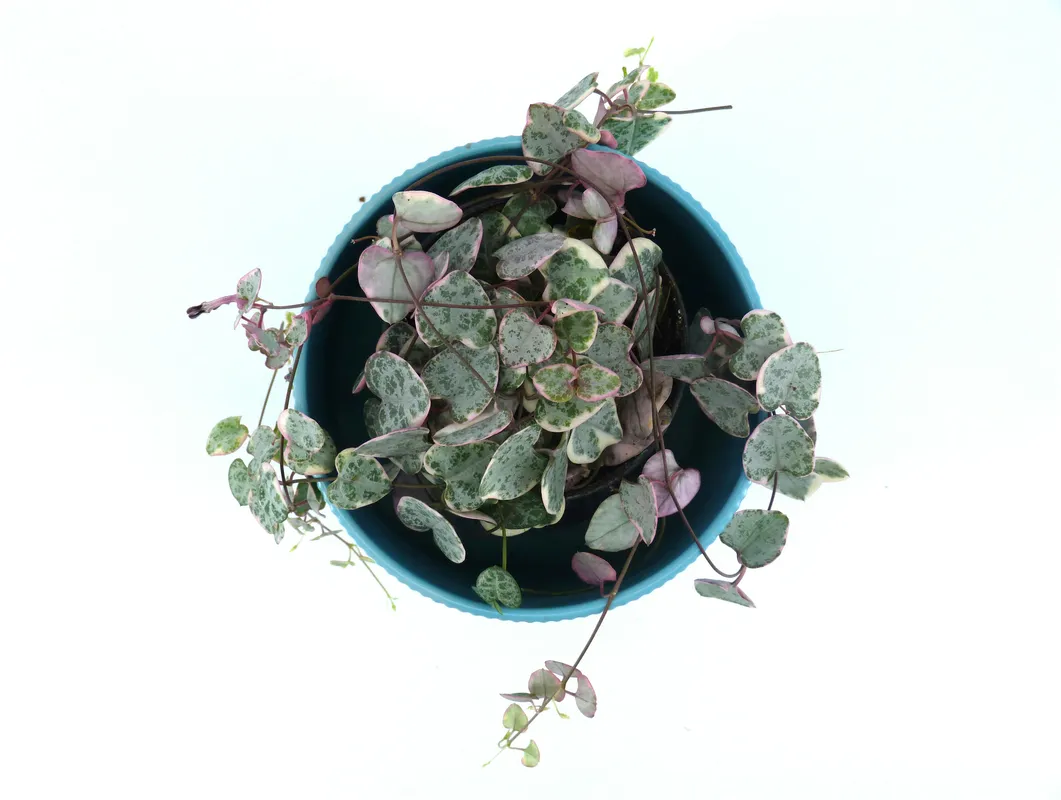
How to Propagate String of Hearts: Three Methods for Endless Trailing Vines
I made a mistake last spring. I told my daughter she could have “a piece” of my String of Hearts. She proceeded to hack off about two feet of vine while I was making lunch. I stood there holding my sandwich, staring at the severed strand on the kitchen counter, trying to remind myself that she is my child and I love her.
Good news, though: every single one of those cuttings rooted. String of Hearts (Ceropegia woodii) is one of the most forgiving plants to propagate, and it gives you multiple ways to do it. Whether you have a long vine, a tiny cutting, or just a weird little tuber growing along the stem, you can turn it into a whole new plant.
Here are three methods that actually work, ranked from simplest to most satisfying.
Before You Start: Timing and Tools
The best time to propagate String of Hearts is during the growing season - roughly spring through late summer. The plant is actively growing and will root much faster. You can propagate in fall or winter, but expect things to take twice as long.
You will need:
- A healthy String of Hearts with vines at least a few inches long
- Clean, sharp scissors or small pruning shears
- A clear glass or jar (for water propagation)
- Small pots with well-draining soil (for soil methods)
- Optional: rooting hormone powder
- Optional: a clear plastic bag for the butterfly method
That is the full supply list. No fancy equipment. No grow tent. Just kitchen counter stuff.
Method 1: Water Propagation (The Easiest)
This is where most people start, and for good reason. It is dead simple, and you get to watch roots grow in real time through the glass. My kids love checking on the cuttings every morning like they are tiny science experiments.
How to do it
- Cut a vine that is at least 4 to 6 inches long. Cut just below a node - that is the small bump where leaves attach to the stem.
- Remove the leaves from the bottom 2 to 3 inches of the cutting. This part will be submerged, and leaves left underwater will rot and make the water murky.
- Place the cutting in a clear glass or jar with room-temperature water. Make sure at least one or two nodes are submerged.
- Set it in a spot with bright, indirect light. A windowsill works great.
- Change the water every 3 to 5 days to keep it fresh and oxygenated.
What to expect
You should see tiny white roots poking out from the nodes within 1 to 3 weeks. Once the roots are about an inch or two long, you can transplant into soil. Do not wait too long - water roots get lazy if they stay in water forever, and the transition to soil gets harder.
Common mistakes
- Putting the cutting in direct sun. The water heats up and cooks the cutting. Bright indirect light only.
- Forgetting to change the water. Stagnant water breeds bacteria and your cutting will rot instead of root.
- Submerging leaves. Strip them off. They will rot and take the whole cutting with them.
Method 2: The Butterfly Method (The Most Satisfying)
This is my favorite method when I want to create a full, bushy new plant instead of just one or two trailing vines. It takes a little more patience, but the result is worth it.
The butterfly method gets its name from how the cuttings look - each one is a single node with a pair of leaves on either side, like little butterfly wings.
How to do it
- Take a long vine and cut it into individual segments. Each segment should have one node with its pair of leaves. Cut the vine between each pair of leaves so every piece has its own node.
- Fill a small pot with moist, well-draining soil. A mix of regular potting soil with perlite works well.
- Lay each little “butterfly” cutting flat on the surface of the soil, pressing the node gently into contact with the soil. Do not bury them - just make sure the node touches the soil surface.
- Space them about an inch apart. You can fit a lot of cuttings in one small pot, which is what gives you that full, bushy look.
- Mist the soil lightly and cover the whole pot with a clear plastic bag to create a humidity dome. Poke a few small holes for airflow.
- Place it in bright, indirect light.
What to expect
Within 2 to 4 weeks, the nodes will send roots down into the soil and new growth will start to emerge. Once you see new vines growing, you can remove the plastic bag and start watering normally.
This method takes a little longer than water propagation, but you end up with a much fuller plant. Instead of one or two vines, you get a dozen or more all growing from the same pot. It is extremely satisfying when those new vines start cascading over the edge.
Common mistakes
- Burying the cuttings too deep. The node needs light and air. Just press it onto the surface.
- Keeping the soil too wet. Moist, not soaking. String of Hearts is semi-succulent and will rot in soggy soil.
- Removing the humidity dome too early. Wait until you see actual new growth, not just roots.
Method 3: Tuber Propagation (The Easiest of All)
This is honestly the lowest-effort method, but it requires that your plant has already produced aerial tubers. These are small, round, bead-like growths that form along the vines. They look like tiny potatoes or marbles, and they are the plant’s natural way of reproducing.
Not every String of Hearts produces a lot of tubers, but mature plants that get good light usually develop them along their vines. If yours has them, congratulations - free plants with almost zero effort.
How to do it
- Find an aerial tuber on one of the vines. It will be a round, brownish-green bump, usually at a node.
- You have two options here:
- Leave it attached: Press the tuber gently into the soil of a nearby pot while the vine is still connected to the mother plant. Pin it down with a small piece of bent wire or a bobby pin if needed.
- Cut it off: Snip the vine on both sides of the tuber, leaving a couple inches of stem attached. Place the tuber on moist soil in a small pot.
- Keep the soil lightly moist. Not wet, just moist.
- Place in bright, indirect light.
What to expect
Tubers root incredibly fast - usually within 1 to 2 weeks. If you left the tuber attached to the mother plant, just wait until it has clearly rooted and is producing new growth, then cut it free. This method has the highest success rate because the tuber already has stored energy and nutrients ready to fuel new growth.
Common mistakes
- Being too rough with tubers. They are firm but can bruise. Handle gently.
- Overwatering. These are essentially little succulent storage organs. They need moisture but hate being waterlogged.
- Trying to propagate tubers in winter. They will sit there doing nothing for months. Wait for spring.
Which Method Should You Choose?
Honestly, all three work well. Here is my general advice:
- Want to watch the process? Water propagation. Great for kids and impatient people (like me).
- Want a full, bushy new plant? Butterfly method. More cuttings equals more vines from day one.
- Want the easiest possible route? Tuber propagation. If your plant has tubers, just press them into soil and wait.
You can also combine methods. I usually do water propagation with long cuttings and the butterfly method with shorter pieces. Use everything. Waste nothing. This is the Asian dad way.
After Propagation: Caring for New Plants
New String of Hearts plants need a little extra attention for the first few weeks:
- Light: Bright, indirect light. These plants can handle some direct morning sun, but harsh afternoon rays will scorch young leaves.
- Water: Water when the soil is completely dry. These are semi-succulent plants, so err on the side of underwatering. Overwatering is the number one killer of String of Hearts at any age.
- Soil: Well-draining is essential. A succulent or cactus mix works well, or regular potting soil mixed with extra perlite.
- Fertilizer: Skip fertilizing for the first month after transplanting. Once the plant is established and actively growing, use a diluted balanced fertilizer monthly during the growing season.
The Plant That Keeps Giving
Here is what I love about String of Hearts propagation: it is almost impossible to mess up. Even my daughter’s enthusiastic pruning session turned into eight new plants that I gave to neighbors and coworkers. One of them came back to me six months later in a macrame hanger, three times bigger than when I gave it away.
If you have a String of Hearts that is getting leggy or you just want more of this lovely trailing plant in your life, pick a method and give it a shot. Spring is the perfect time to start, and by summer you will have more heart-shaped vines than you know what to do with.
Just maybe hide the scissors from your kids.