How to Set Up a Plant Shelf in a Small Apartment (Without Losing Your Mind)
Let me paint you a picture. You live in a two-bedroom apartment. You have a toddler, a partner, a cat who thinks every flat surface belongs to her, and somehow forty-seven houseplants. You have run out of windowsill. You have run out of counter space. The bathroom vanity currently hosts three ferns and a prayer plant that seems to be thriving on shower steam and existential dread.
Sound familiar? Yeah. That is my life.
At some point, every plant parent in a small space reaches the same conclusion: the only direction left to grow is up. Vertical gardening is not just a Pinterest aesthetic - it is a survival strategy. And if you do it right, a single wall or corner can hold more plants than you ever thought possible.
Here is everything I have learned about setting up plant shelves in a small apartment, including the mistakes I made so you do not have to.
Why Go Vertical?
The math is simple. A typical windowsill holds maybe four to six pots. A well-placed shelf system on the same wall can hold twenty or more. You are multiplying your plant real estate without sacrificing a single square foot of floor space - and when you live in a New York City apartment, floor space is basically currency.
But there are other benefits too. Grouping plants on shelves creates a mini microclimate. The plants share humidity, which is a huge deal in winter when your radiator turns the air into the Sahara. Trailing plants get to actually trail instead of sitting in a sad pile on a table. And taller plants do not block light from shorter ones when you arrange everything on tiers.
Plus, and I say this as a dad whose living room doubles as a playroom, plants on shelves are harder for tiny hands to reach. That alone is worth the investment.
Choosing the Right Shelf Type
Not all shelves are created equal, especially when you add the weight of pots, soil, and water. Here is what I have tried and what actually works.
Floating Shelves
These are the clean, modern option. They mount directly to the wall and take up zero floor space. I have two sets of floating shelves flanking my living room window, and they hold about a dozen small pots between them.
The catch: you need to mount them into studs or use heavy-duty anchors. A six-inch pot full of wet soil weighs more than you think. I learned this when a shelf full of succulents came down at 2 AM and scared the cat so badly she did not come out from under the bed for a full day. Use a stud finder. Please.
Best for: small pots, succulents, trailing plants that cascade beautifully over the edge.
Ladder Shelves
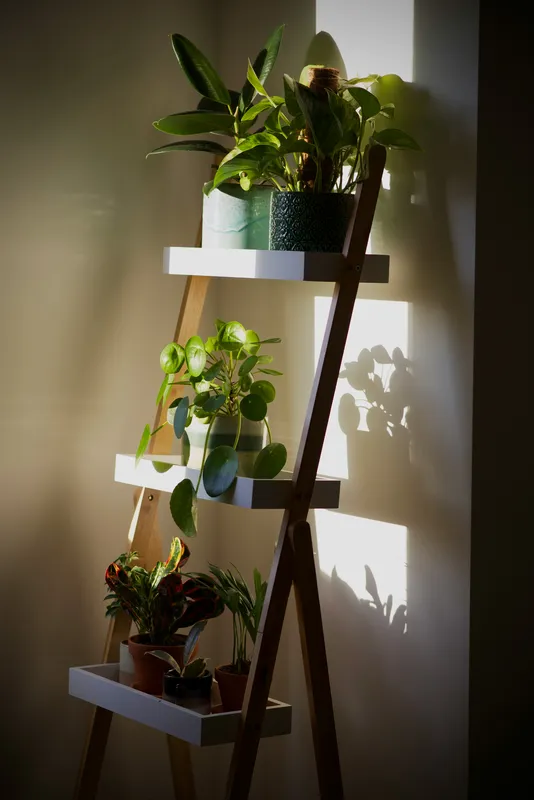
A freestanding ladder shelf leans against the wall and gives you four to six tiers of space. I love these because you do not need to drill anything - great for renters. The tiered design also naturally gives taller plants more headroom on the lower shelves and smaller plants up top.
Best for: mixed collections with different pot sizes, anyone who does not want to put holes in the wall.
Wire Rack Shelving
This is the workhorse option. Those metal wire shelves you see in restaurant kitchens? They work beautifully for plants. They are strong enough to hold heavy ceramic pots, the open wire lets light filter through to lower shelves, and you can adjust shelf heights to fit your tallest plants.
I have a three-tier wire rack near my east-facing window that holds my entire aroid collection. It is not the prettiest setup, but it is functional and sturdy. You can dress it up with woven baskets or decorative pot covers if you care about aesthetics. I mostly care about whether the Monstera is getting enough light.
Best for: heavy pots, collections that need adjustable spacing, people who value function over form.
Hanging Shelves
Ceiling-mounted or wall-bracket shelves that hang from ropes or chains are great for catching light near windows without blocking the view. They work best for lightweight plants - think small pothos cuttings, air plants, or herbs in tiny pots.
Fair warning: these sway. If you have a cat, the swaying is basically an invitation. Proceed with caution.
The Light Factor
Here is the most important thing about shelf placement that people get wrong: light does not distribute evenly across shelves.
The top shelf near a window gets significantly more light than the bottom shelf. I have tested this with a light meter, and the difference can be dramatic - the top shelf might get 400 foot-candles while the bottom gets 80. That is the difference between a plant that thrives and a plant that slowly stretches toward the light like it is reaching for help.
So you need to think about plant placement like a seating chart at a wedding. Everyone has different needs, and putting the wrong guest in the wrong spot creates drama.
Top shelves (most light): Succulents, cacti, Hoya, anything that wants bright indirect light. These are your sun lovers.
Middle shelves: Pothos, Philodendron, Peperomia, Pilea. The easy-going crowd that does well in medium light.
Bottom shelves: Ferns, Calathea, low-light tolerant plants like ZZ plants or cast iron plants. These are the ones that actually prefer less light.
If your shelf setup is far from natural light, a small LED grow light strip mounted under each shelf can make a huge difference. I added clip-on grow lights to my wire rack, and the difference in growth was noticeable within a few weeks.
Spacing Matters More Than You Think
One of my early mistakes was cramming as many pots as possible onto every shelf. More plants, more happiness, right? Wrong. I ended up with a wall of tangled leaves, zero airflow, and a fungus gnat situation that I still do not like to talk about.
Here is what I learned:
Leave 12 to 18 inches of vertical space for trailing plants so they have room to cascade without touching the shelf below. For upright growers like snake plants or Alocasia, you want 18 to 24 inches. When leaves press against the shelf above them, airflow drops, moisture gets trapped, and you are basically creating a humidity chamber for mold and pests.
Give each pot at least two inches of breathing room on either side. Yes, this means fewer plants per shelf. But healthier plants that actually grow are better than a packed shelf of stressed ones.
Practical Tips from a Plant Dad
After three years of shelf experimentation in a small apartment, here are the things I wish someone had told me from the start.
Use saucers or trays under every pot
Water will drip. It will stain wood shelves, rust metal ones, and eventually damage your wall. I use cheap plastic saucers under everything, and for my floating shelves, I line them with clear shelf liner as extra insurance.
Rotate your plants regularly
Plants on shelves tend to grow toward the light source, which means they get lopsided fast. I do a quarter-turn every time I water. It takes two seconds and keeps everything growing evenly.
Make watering easy on yourself
If your shelf is high up, watering becomes a logistics challenge. I keep a long-spout watering can specifically for shelf plants, and for the really hard-to-reach spots, I use a squeeze bottle. Nobody wants to be standing on a step stool with a full watering can while a toddler asks for a snack.
Think about your wall
If you are mounting shelves near plants that like humidity - ferns, Calathea, anything tropical - be aware that moisture can damage drywall over time. I keep my humidity-loving plants on freestanding shelves rather than wall-mounted ones. Learned that one the hard way when I noticed a suspicious soft spot behind my fern shelf.
Start with one shelf
I know the temptation is to immediately build a floor-to-ceiling plant wall. Resist it. Start with one shelf, see how the light works, see how watering goes, see if the cat decides it is her new perch. Adjust from there. My current setup evolved over two years, and every iteration taught me something.
My Favorite Budget Setup
If you want a recommendation for where to start, here is what I would do on a budget:
Get a basic five-tier wire shelf unit. They cost around thirty to fifty dollars and can hold a serious number of plants. Place it near your best window. Put your light-loving plants up top, medium-light plants in the middle, and low-light plants at the bottom. Add a clip-on grow light if the lower shelves seem too dark. Use cheap plastic nursery pots inside decorative covers - this way you can easily pull plants out for watering and inspection without wrestling with heavy ceramic.
Total investment: under a hundred dollars. Total plant capacity: twenty-five or more pots, depending on size.
That is a pretty good deal for a New York apartment.
The Real Secret
Here is the thing I have come to believe after years of cramming plants into every available inch of our apartment. The goal is not to have the most plants. The goal is to have happy plants in a space that still feels like a home.
My daughter likes to count the plants on my wire rack when she wakes up in the morning. My son pats the trailing pothos like it is a pet. My wife tolerates the whole situation with remarkable patience, though she has drawn a firm line at the bedroom (“No more plants in here. I mean it.”).
A well-set-up plant shelf is not just storage. It is a little ecosystem you built with your own hands, in a corner of your apartment that used to be empty. And every time a new leaf unfurls on the top shelf, or a trailing vine reaches a little further down, it feels like a small victory.
In a city where space is tight and life moves fast, those small victories matter.
Now if you will excuse me, I need to go rotate the plants on shelf three. And maybe move the cat off shelf two.