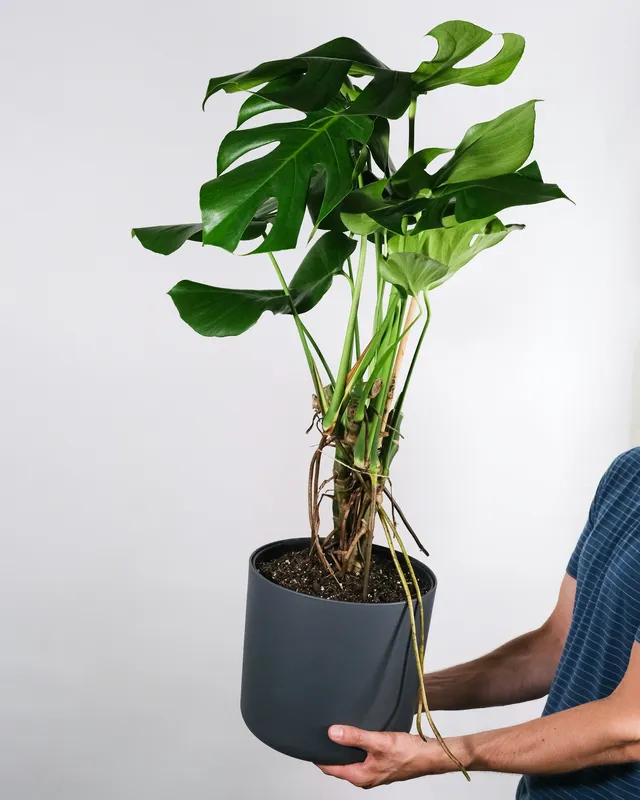
Monstera Aerial Roots: Keep Them, Cut Them, or Train Them?
Your monstera has roots growing out of the stem. Not from the soil. From the stem, just dangling in the air like weird brown noodles.
You are probably wondering: Is this normal? Should I cut them? Are they stealing nutrients from the plant?
Short answer: They are completely normal, and you should probably leave them alone. But you have options, and the right choice depends on what you want your monstera to look like and how you want it to grow.
What Aerial Roots Actually Are
Aerial roots are adventitious roots that grow from the nodes on a monstera’s stem. They look different from the underground roots you see when you repot — aerial roots are typically thicker, woodier, and brown or gray in color.
In the wild, monsteras are climbing vines that grow on the trunks of large trees in tropical forests. They use aerial roots to:
- Anchor themselves to tree bark so they can climb toward the canopy
- Absorb moisture from humid air as a supplemental water source
- Stabilize the plant as it grows larger and heavier
- Access nutrients from decomposing organic matter caught in tree bark crevices
Indoors, they still grow aerial roots because that is what monsteras are programmed to do. Even if your plant is not climbing anything, the roots will appear at the nodes as the plant matures. A young monstera might not have any, but once it is a couple of years old and putting out mature leaves, aerial roots usually follow.
Should You Cut Them?
You can, but you do not have to. Neither choice will kill the plant.
Reasons to leave them:
- They help the plant absorb extra moisture from the air
- They provide structural support, especially for climbing plants
- They are a sign of a healthy, actively growing monstera
- Cutting them creates a wound that the plant has to heal, which uses energy
Reasons to cut them:
- They look messy and you prefer a cleaner appearance
- They are poking into nearby furniture or walls
- The plant has so many that it is getting tangled
- You are not using a support and the roots serve no practical purpose
If you do cut them, use clean, sharp scissors or pruning shears and cut close to the stem without cutting into the stem itself. The plant will be fine. It will likely grow new aerial roots from the same or nearby nodes over time, so this is not a one-time fix if you prefer the clean look.
Better Option: Train Them
Instead of cutting, guide the aerial roots into the soil or onto a support structure. This is the best option for the health and appearance of the plant because it mimics what the monstera would do naturally.
Training roots into soil:
- Gently bend an aerial root toward the pot
- Bury the tip one to two inches into the potting mix
- The aerial root will transition into a functioning soil root over a few weeks
- This gives the plant an additional anchor and nutrient source, which supports larger leaf growth
Training roots onto a moss pole:
- Wrap the aerial root loosely around a moss pole or coco coir pole
- Secure with soft plant ties if needed, but do not tie tightly
- Mist the pole regularly so the roots have moisture to grip onto
- Over time, the roots will attach to the pole on their own
Training roots onto a plank or board:
- Some growers mount monsteras on wooden boards wrapped in sphagnum moss
- Aerial roots grip into the damp moss and anchor the plant
- This creates a more natural, jungle-like display
The benefit of training aerial roots is that a climbing monstera produces bigger, more fenestrated (split) leaves. If you have ever wondered why your monstera’s new leaves are smaller or have fewer holes than expected, giving it something to climb is often the answer.
Using a Moss Pole (Step by Step)
If your monstera is getting tall and you want it to climb properly, a moss pole is the best investment you can make.
Steps:
- Insert a moss pole into the center of the pot, pushing it deep enough to be stable. Do this during repotting if possible to avoid damaging existing roots.
- Position the monstera’s main stem against the pole
- Tie the stem loosely to the pole with soft ties, velcro strips, or jute twine at two or three points
- Guide any existing aerial roots onto the pole and tuck them into the moss
- Mist the pole regularly — daily in dry homes, every few days in humid ones — so the roots have moisture to grip onto
- As the monstera grows taller, extend the pole or add another on top
Why it works: When a monstera’s aerial roots have something to grip, the plant interprets this as climbing success and starts producing bigger, more mature foliage. Climbing monsteras in the wild produce leaves that are two to three feet across with dramatic splits and holes. While your indoor plant will not reach that size, it will produce noticeably larger and more fenestrated leaves with proper support.
DIY Moss Pole vs Store-Bought
Store-bought coco coir poles are convenient and affordable. They work fine but are often too short and too thin for larger monsteras. You may need to stack multiple poles.
DIY moss poles made with PVC pipe wrapped in sphagnum moss and secured with fishing line or mesh are better for larger plants. They retain moisture better, provide more surface area for roots, and can be made to any height.
Bendable moss poles made from metal mesh filled with sphagnum moss are another good option. They can be reshaped as your plant grows.
Common Mistakes
- Cutting all aerial roots because they look weird. They are functional and help the plant. Leave at least some if you can.
- Forcing a root to bend sharply. Aerial roots can snap if bent too aggressively. Guide them gradually over a few days.
- Ignoring them when your plant needs support. A top-heavy monstera with no support and no anchored aerial roots will eventually lean or fall over.
- Never misting a moss pole. A dry moss pole is just a stick. The roots need moisture to attach. Mist it regularly.
- Using wire ties that are too tight. Tight ties cut into the stem as it grows. Use soft ties and check them every few months.
What Aerial Roots Tell You About Your Plant
The condition of aerial roots can give you clues about your monstera’s health and environment:
- Lots of healthy, green-tipped aerial roots = happy, actively growing plant with good humidity
- Dried, shriveled, papery roots = low humidity. The air is too dry for the roots to function. Consider a humidifier or more frequent misting.
- No aerial roots on a mature plant = might need more light, a climbing support, or both. Monsteras that are not climbing sometimes produce fewer aerial roots.
- Roots growing aggressively toward the floor = the plant is searching for something to anchor to. Give it a moss pole.
- Soft, mushy aerial roots = unusual and may indicate overwatering or a fungal issue. Check the main root system for rot.
What To Do Next
- If you want your monstera to climb, set up a moss pole now. The sooner you start, the easier it is to train the plant.
- If you are dealing with a monstera that will not produce split leaves, check light levels and add a climbing support. Both make a big difference.
- If you liked this, learn about training other aroids like philodendrons and pothos, which also produce aerial roots and benefit from climbing support.