If you grew up in or around a Chinese American community, you know the money tree.
Not because anyone ever sat you down and explained it. You just absorbed it, the way you absorbed that shoes come off at the door and rice cookers are never unplugged. There was always a Pachira aquatica standing somewhere important - next to the register at your uncle’s restaurant, on the counter of the bakery where your mom bought egg tarts, in the corner of your grandmother’s living room where the afternoon light came through the curtains.
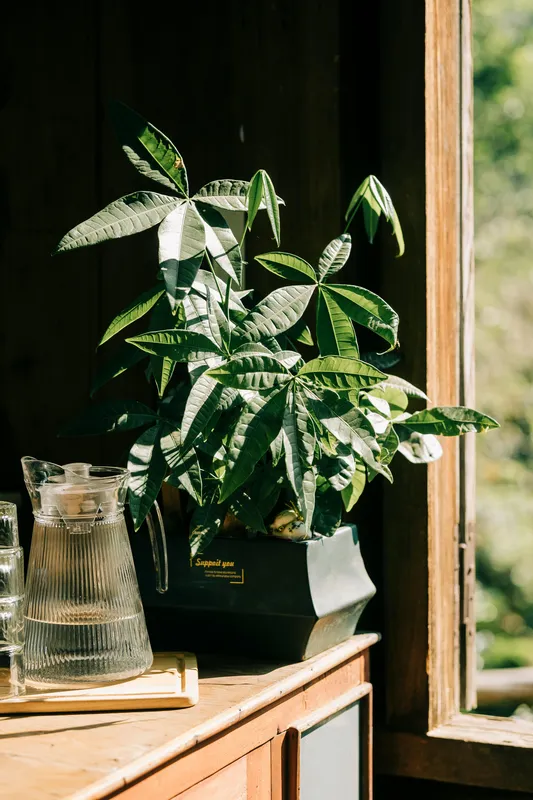
The braided trunk, the glossy green leaves fanning out like open hands. It was part of the furniture. Part of the family, almost.
I never questioned it until I moved into my first apartment and my dad showed up with one in a red ceramic pot. He placed it on the table by the front door, adjusted it twice, and said, “For good luck.” That was it. No further explanation needed.
Now I’m a dad myself, and there’s a money tree by our front door too. Some traditions you don’t break.
What Even Is a Money Tree?
Let’s get the botany out of the way. The money tree is Pachira aquatica, a tropical tree native to Central and South America. In the wild, it grows in swamps and wetlands and can reach over 50 feet tall. The ones in our living rooms are a much more modest version, usually kept between two and six feet.
The braided trunk thing? That’s entirely a human invention. The story goes that a Taiwanese truck driver in the 1980s started braiding young Pachira stems together and selling them as ornamental plants. The braided look caught on in a massive way. Today, it’s hard to find a money tree that isn’t braided.
Pachira aquatica produces compound leaves with five to seven leaflets radiating from a central point. In feng shui, those five leaflets are significant - they’re said to represent the five elements: water, earth, fire, wind, and metal. If you find a stalk with seven leaves, that’s considered extremely lucky. My dad would probably frame it.
Why It Matters in Chinese Culture
The money tree’s place in Chinese households and businesses isn’t random decoration. It’s rooted (pun intended) in feng shui, the ancient Chinese practice of arranging your environment to promote the flow of positive energy, or qi.
Pachira aquatica is believed to attract wealth and prosperity. The braided trunk is said to trap positive energy and channel it outward. The upward-growing leaves symbolize financial growth. Place it in the southeast corner of your home - the “wealth corner” in feng shui - and you’re setting yourself up for abundance. At least, that’s the idea.
In practice, the money tree became one of the most popular housewarming and business-opening gifts in Chinese culture. When a new restaurant opened in our neighborhood, it would receive at least three or four money trees from well-wishers. My uncle’s restaurant had so many lined up by the door that it looked like a small jungle.
I remember asking my grandmother why everyone gave the same plant. She looked at me like I’d asked why people eat rice. “Because it works,” she said.
Did it work? My uncle’s restaurant stayed open for 22 years, so I’m not going to argue with her.
The One in My Dad’s Restaurant
My dad ran a small takeout place in Queens for most of my childhood. The money tree sat next to the register on a shelf that also held a ceramic lucky cat, a small shrine with oranges and incense, and a framed photo of our family.
That shelf was sacred. Nobody touched it except my dad. He watered the money tree every Saturday morning, turning the pot a quarter turn each time so the leaves grew evenly. He wiped the leaves with a damp cloth once a month. I don’t think he knew anything about Pachira aquatica as a species - he just knew this was an important plant and he was going to take care of it.
The tree outlasted three cash registers, two renovations, and one small kitchen fire. When my dad finally closed the restaurant, the money tree was one of the last things he carried out. It lives in my parents’ living room now, still in the same red pot, still standing guard.
I think about that a lot. How a plant can hold so much meaning just by being present. By surviving alongside you.
How to Actually Keep a Money Tree Alive
Here’s the good news: Pachira aquatica is one of the more forgiving houseplants you can own. It’s not a diva. It doesn’t demand perfection. It just needs a few basics handled well.
Light
Money trees want bright, indirect light. An east-facing window is perfect - morning sun without the harsh afternoon blaze. They’ll tolerate lower light conditions and even do fine under fluorescent lights (which explains why so many thrive in restaurants and offices), but they’ll grow faster and fuller with good light.
Direct sun can scorch the leaves, especially in summer. If you notice brown, crispy patches on the leaf edges, move it back from the window a foot or two.
Water
This is where most people get into trouble. Money trees like consistent moisture but absolutely cannot sit in waterlogged soil. Water when the top inch of soil feels dry - stick your finger in to check. In summer, that might be once a week. In winter, more like every two to three weeks.
The number one killer of money trees is overwatering. If the leaves are turning yellow and the stems feel soft or mushy, you’re watering too much. Cut back, make sure the pot has drainage holes, and let the soil dry out more between waterings.
My dad’s Saturday watering schedule worked because the restaurant was warm and dry from all the cooking. Your watering rhythm will depend on your specific conditions - the temperature, humidity, pot size, and how much light the plant gets.
Soil
Use a well-draining potting mix. A standard indoor plant mix with some added perlite works great. You want the soil to hold some moisture but let excess water flow through easily. If water sits on the surface for more than a few seconds after you pour it, the soil is too compacted.
A mix of equal parts peat moss (or coco coir), perlite, and regular potting soil is a solid recipe.
Humidity and Temperature
Money trees are tropical, so they appreciate some humidity. Aim for at least 50% if you can. In dry winter months, a pebble tray with water underneath the pot helps. You can also group it with other plants - they create their own little microclimate.
Temperature-wise, keep it between 65 and 80 degrees Fahrenheit. It can handle brief dips to 50 degrees, but prolonged cold will stress it out. Keep it away from drafty windows and heating vents.
Feeding
During the growing season - roughly March through September - feed with a balanced liquid fertilizer diluted to half strength every two weeks. In fall and winter, stop fertilizing entirely. The plant is resting, and excess nutrients can build up in the soil and burn the roots.
Common Problems and How to Fix Them
Leaf Drop
Some leaf drop is normal, especially after you bring a new plant home or move it to a different spot. Money trees don’t love change. Give it a couple of weeks to adjust before you panic.
If leaf drop is persistent, check your watering. Overwatering is the usual suspect, but underwatering and sudden temperature changes can also trigger it.
Yellow Leaves
Yellow leaves almost always mean too much water. Check the soil - if it’s soggy, let it dry out completely before watering again. If the roots look brown and mushy when you check them, you may need to repot into fresh, dry soil and trim away the damaged roots.
Leggy Growth
If your money tree is stretching toward the light and looking sparse, it needs more brightness. Move it closer to a window or supplement with a grow light. Rotate the pot regularly so it grows evenly on all sides.
Brown Leaf Tips
Usually a humidity issue. Try misting the leaves, adding a pebble tray, or moving it away from heating vents. Inconsistent watering can also cause brown tips - the plant doesn’t love going from bone dry to soaked.
The Braided Trunk - A Quick Note
If you have a braided money tree and the trunks start separating at the top, that’s normal. The individual trunks are separate plants braided together when they were young and flexible. As they mature and thicken, they may spread apart a bit. You can gently continue the braid as new growth appears, or just let it do its thing.
Sometimes one trunk in a braided arrangement will die while the others survive. It happens - the individual plants are competing for resources. If a trunk feels soft and hollow, it’s gone. You can leave it or carefully remove it without disturbing the roots of the surviving trunks too much.
Passing It Down
My daughter is three, and she’s already aware of the money tree by our front door. She calls it “the lucky plant.” She gives it a little wave when we leave the house in the morning, which is the most heart-melting thing I’ve ever seen.
I don’t know if she’ll grow up to care about feng shui or plant symbolism. But I hope she grows up knowing that some things in a home are there for a reason beyond decoration. That the money tree by the door is a small, quiet act of hope - a way of saying, “May good things come to this house and the people who live here.”
My dad didn’t explain any of that when he dropped off that first money tree at my apartment. He just said, “For good luck.” But I understood. I’ve always understood.
If you don’t have a money tree yet, go get one. Put it somewhere you’ll see it every day. Water it on Saturdays. Turn it a quarter turn each time.
And if someone asks why, just tell them: “Because it works.”