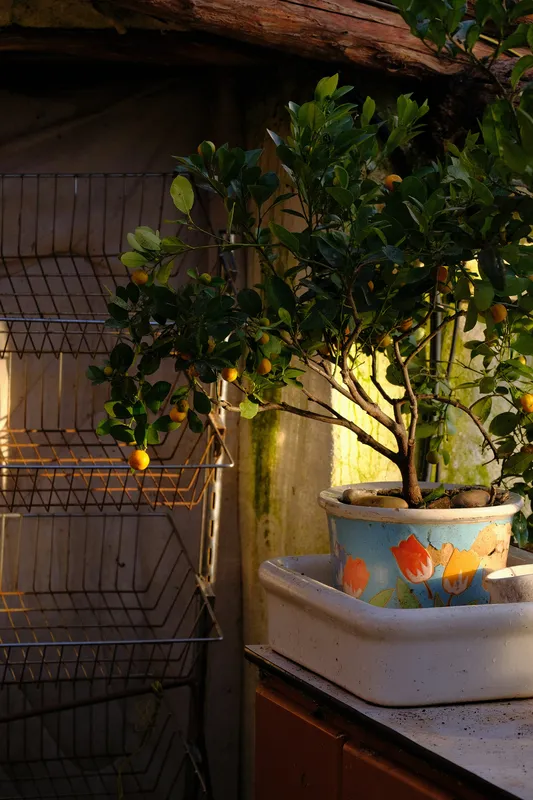
The Kumquat Tree That Brings Gold to Our Living Room Every New Year
Every January, my mom starts asking the same question. “Did you get the kumquat tree yet?”
She asks it like I might forget. Like there is a version of Lunar New Year that does not involve a potted citrus tree sitting by the front door, loaded with tiny golden fruit the size of large grapes. In my parents’ house growing up in Flushing, the kumquat tree showed up every year around the same time the red envelopes came out. It was as essential to the holiday as dumplings and firecrackers and my dad yelling at the TV during the CCTV New Year’s Gala.
For years I bought a fresh kumquat tree from the flower market on Main Street every January, kept it alive through the holiday, and then watched it slowly die by March. Classic. But three years ago I decided I was going to actually keep one going year-round. An indoor kumquat tree, in our apartment, like a real plant person. My wife thought I was being optimistic. She was mostly right, but the tree is still alive, so I am calling it a win.
Why Kumquats Are Everywhere During Lunar New Year
If you have ever walked through Chinatown in late January, you have seen them. Kumquat trees - sometimes called jin ju in Mandarin - lined up outside every florist, grocery store, and sidewalk vendor, their branches weighed down with bright orange-gold fruit.
The symbolism is not subtle, and that is the point. The Chinese name for kumquat, jin ju, sounds a lot like “golden luck.” The word jin means gold, and ju sounds nearly identical to ji, meaning luck or good fortune. So a kumquat tree sitting by your front door is basically a neon sign to the universe that says “send money and good things this way, please.”
But it goes deeper than wordplay. The round golden fruit are supposed to look like coins. A tree heavy with fruit represents abundance and prosperity. If you can find a tree that has flowers, green fruit, and ripe fruit all at the same time, that is even better - it symbolizes continuity across generations, past, present, and future, all thriving together. My mom always picks the trees with the most fruit. She counts them. Odd numbers are bad luck, apparently. Even numbers only.
In our family, the tree goes by the front door on New Year’s Eve and stays there through the fifteenth day of the new year, which is the Lantern Festival. My dad used to tie red envelopes to the branches. When I was a kid I thought this was a decoration. Turns out he was hiding actual money in there. My brother and I did not figure this out until we were embarrassingly old.
The Year I Decided to Keep One Alive
Here is the thing about those Chinatown kumquat trees: they are not really sold as long-term houseplants. They are holiday decorations. The growers force them into heavy fruiting for the season, and by the time you buy one, the tree has given everything it has. Keeping it alive afterward is like asking a marathon runner to immediately run another marathon.
I killed three of them before I accepted this. Each time the same pattern: gorgeous through February, dropping leaves by March, completely bare by April. My wife started calling them “seasonal sacrifices.”
But then I found a proper dwarf Nagami kumquat from an online citrus nursery, not a holiday display tree, and I decided to do it right. A real kumquat tree, grown for the long haul. It arrived in a five-gallon pot, about two feet tall, with dark glossy leaves and exactly zero fruit. Not exactly the golden abundance I was going for. But you have to start somewhere.
What I Have Learned About Growing Kumquats Indoors
Three years in, and the tree is thriving. It fruited for the first time last winter - just eight kumquats, but I texted my mom a photo like I had won an Olympic medal. Here is what I have figured out along the way.
Light Is Everything
This is the single most important factor for indoor kumquats, and it is the reason most people fail. Kumquats need a minimum of six to eight hours of direct sunlight per day. Not bright indirect light. Not “near a window.” Actual sun hitting the leaves.
Our apartment has a south-facing window in the living room, and that is where the tree lives from October through May. During summer, it goes out on our fire escape (technically not allowed, but we are not the only ones doing this in our building). If you do not have a south-facing window, you will almost certainly need a grow light. A full-spectrum LED panel running twelve hours a day will work. It is not pretty, but it keeps the tree alive through a New York winter.
Watering: Less Than You Think
Kumquats are citrus, and citrus does not like wet feet. I water mine when the top inch of soil feels dry, which in winter means roughly once a week. In summer, especially when it is outside, it might be every three or four days. The key is to water deeply - let it run through the drainage holes - and then leave it alone until the soil dries out again.
I killed my second holiday kumquat by overwatering. The leaves turned yellow, then brown, then the whole thing smelled like a swamp. Root rot is fast and merciless with citrus trees. If you are the type of plant parent who likes to water on a schedule (guilty), set a reminder to check the soil first and only water if it is actually dry.
Soil and Drainage
Regular potting mix holds too much moisture for citrus. I use a cactus and citrus mix with extra perlite stirred in - maybe a 70/30 ratio. The pot needs drainage holes. No exceptions. I also put a layer of small stones at the bottom, though I know some people say that is a myth. It makes me feel better.
Kumquats prefer slightly acidic soil, in the pH range of 5.5 to 6.5. If your tap water is alkaline (like most New York City water), you might see yellowing leaves over time. I water with filtered water now, which seems to help.
Humidity and Temperature
Kumquats are more cold-tolerant than most citrus. They can handle temperatures down to about 18 degrees Fahrenheit for short periods, which is wild for a citrus tree. Indoors, they are happy anywhere between 55 and 85 degrees. They actually benefit from a cooler period in winter - a slightly chilly room encourages flowering in spring.
Humidity is where New York apartments get tricky. Our radiator heat drops humidity to maybe 20% in winter, which is desert-level dry. The kumquat handles it better than, say, a calathea (the calathea did not survive the winter, but that is a different story). Still, I run a humidifier nearby and mist the leaves occasionally. Aiming for at least 40% humidity seems to keep the tree happy.
Feeding
Citrus trees are hungry. During the growing season - roughly March through September - I fertilize every two weeks with a citrus-specific fertilizer. The one I use has a higher nitrogen ratio plus micronutrients like iron, zinc, and manganese that citrus trees need. In winter, I cut back to once a month or skip it entirely.
If the leaves start turning pale green or yellow between the veins while the veins stay dark green, that is probably an iron deficiency. A foliar spray of chelated iron fixes it pretty quickly. I learned this the hard way after spending three weeks convinced my tree had some kind of disease.
Getting It to Fruit
Here is the magical part: kumquat trees are self-pollinating. You only need one tree to get fruit. But indoors, you do not have bees or wind doing the work, so you need to help. When my tree flowered in spring, I used a small paintbrush to dab pollen from flower to flower. It felt ridiculous. My daughter asked if I was “painting the tree.” But it worked. Those tiny white flowers eventually became tiny green fruits, which slowly turned gold through the fall.
The flowers smell incredible, by the way. Sweet and citrusy, like orange blossoms. For about two weeks our apartment smelled like a Florida grove instead of a Flushing walkup.
The First Harvest
Eight kumquats. That was our yield. My wife pointed out that you could buy a whole bag of kumquats at the grocery store for three dollars, and that I had spent significantly more than three dollars on soil, fertilizer, a grow light, and a humidifier. She is correct.
But that is not the point. The point is that my kids got to watch a tree go from bare branches to flowers to actual fruit. My daughter ate the first ripe kumquat right off the tree and made the most incredible face because kumquats are sweet on the outside and sour in the middle, which is a confusing experience when you are four.
The point is that when Lunar New Year came around, we had our own kumquat tree with our own golden fruit sitting by the front door. Not a holiday display tree from the sidewalk vendor. Ours. My mom was unreasonably proud.
Eating Kumquats (Yes, the Whole Thing)
If you have never eaten a kumquat, here is the key fact: you eat the entire thing, skin and all. The peel is actually the sweet part - thin, fragrant, and slightly floral. The flesh inside is tart and juicy, almost like a concentrated sour orange. You pop the whole thing in your mouth, chew, and get this amazing sweet-sour combination.
In our family, kumquats show up in a few specific ways during the holiday:
We always have a bowl of fresh kumquats on the table during New Year’s dinner. You grab them like candy between courses. My dad claims eating kumquats on New Year’s Day guarantees a prosperous year, which is the kind of claim that is impossible to disprove.
My mom makes a kumquat preserve by slicing them thin and simmering them with rock sugar and a little salt. It becomes this sticky, sweet-tart syrup that is amazing drizzled over vanilla ice cream or stirred into hot water as a drink. She says it is good for sore throats, which, like the chrysanthemum tea my grandmother swore by, might be more tradition than medicine but I am not going to argue.
Tips If You Want to Try This
If you are thinking about getting your own year-round kumquat tree, here is my honest advice:
Buy from a reputable citrus nursery, not from a holiday display. Look for a Nagami kumquat (the classic oval-shaped variety) or a Meiwa (rounder, sweeter, arguably better for eating fresh). A dwarf variety will stay manageable indoors at about three to five feet tall.
Give it the best light you have. South-facing window minimum. Grow lights if you are serious. This is the number one reason indoor citrus fails.
Be patient. It took my tree two full years before it flowered. You will spend a lot of time just growing a small tree with nice leaves and no fruit. That is normal.
Do not panic in winter. Kumquats naturally slow down and may drop some leaves when days get short. Reduce watering, pull back on fertilizer, and let it rest. It will bounce back in spring.
Get your kids involved. My daughter named our tree “Goldie” and it has been the single most effective way to get her interested in taking care of plants. She checks the soil moisture with her finger every morning. She is more responsible about the kumquat tree than she is about putting her shoes away.
The Tree by the Door
This past Lunar New Year, Goldie had eleven kumquats on her branches. Still not exactly the loaded display trees from Main Street, but more than last year. We tied red string around the pot and put three red envelopes in the branches, following my dad’s tradition. My daughter found the money inside within about four minutes this time. She is getting faster.
My mom came over for New Year’s dinner and inspected the tree the way she inspects everything - thoroughly, with commentary. She adjusted the position of the pot. She removed one leaf that she decided was not up to standard. Then she said, “This is a good tree.”
From my mom, that is essentially a standing ovation.
Next year I am hoping for twenty kumquats. My daughter is hoping for twenty dollars in the red envelopes. We are both being optimistic, and I think that is kind of the point.