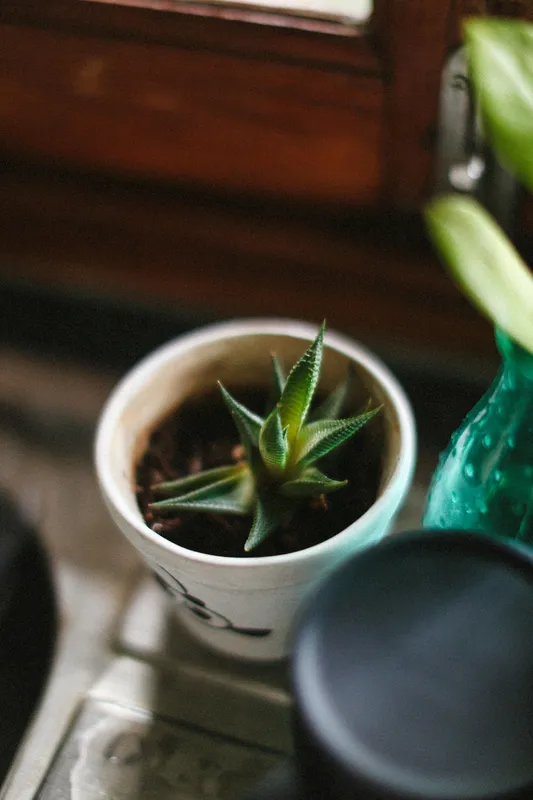
Haworthia Care: The Tiny Succulent That Thrives on Neglect
If you have killed a succulent before, I need you to know something: it was probably not your fault. Most succulents want full desert sun, and most apartments do not have full desert sun. That mismatch is a recipe for a slow, leggy death.
Haworthias are different. These compact little rosettes actually prefer indirect light. They evolved on the forest floor and rocky outcrops of South Africa, tucked under larger plants and shaded by rocks. In other words, they were built for your apartment windowsill.
I discovered haworthias about three years ago when my daughter pointed at one in the grocery store checkout line and said “baby plant.” She was right. It was tiny, it cost four dollars, and it is still alive today. That is more than I can say for the fiddle leaf fig I bought the same month.
What Exactly Is a Haworthia?
Haworthias are small succulents in the family Asphodelaceae - the same family as aloe vera. Most species stay compact, topping out at about four to eight inches tall. They form tight rosettes of thick, fleshy leaves and grow slowly, which is actually a feature, not a bug. You will not be repotting these every six months.
There are over 150 species, but a few show up regularly in nurseries and plant shops:
Haworthia fasciata (Zebra Plant) - The one you have probably seen. Dark green leaves with raised white horizontal stripes on the outside. It looks like a tiny aloe wearing a striped shirt. Compact, sturdy, and extremely forgiving.
Haworthia cooperi - This one is wild. The leaves are translucent and almost look like they are filled with water. When light passes through them, they glow. If you want a conversation starter on your desk, this is it.
Haworthia retusa (Star Window Plant) - Flat-topped, star-shaped rosettes with translucent “windows” at the leaf tips. The plant uses these windows to let light reach the inner leaf tissue. Evolution is showing off with this one.
Haworthia attenuata - Often confused with fasciata, but the white bumps (called tubercles) appear on both sides of the leaves, not just the outside. Equally easy to care for.
Most haworthias at big box stores will be fasciata or attenuata. Either one is a great starting point.
Light
Here is where haworthias really shine for apartment dwellers. They prefer bright, indirect light but will tolerate lower light conditions better than almost any other succulent.
Best light: Bright indirect light near an east-facing or north-facing window. A few feet back from a south or west-facing window also works well.
Will tolerate: Medium indirect light, office lighting, bathrooms with a window. They will grow more slowly in lower light, but they will not throw a fit about it.
Avoid: Harsh direct afternoon sun. Unlike their desert-loving cousins, haworthias can burn in direct sunlight. The leaves will turn reddish-brown or develop white, papery burn marks.
Pro tip: If your haworthia starts stretching upward and the rosette gets loose and open (called etiolation), it needs more light. Move it closer to a window. The new growth will be compact again, though the stretched leaves will stay stretched. Think of it as a record of its journey.
Watering
Overwatering kills more haworthias than anything else. These plants store water in their thick leaves and can go a surprisingly long time between drinks.
The rule: Water thoroughly when the soil is completely dry, then let it dry out again. In spring and summer (the active growing season), that usually means every two to three weeks. In winter, you can stretch it to once a month or even less.
How to water: Soak the soil until water runs out the drainage holes. Then leave it alone. Do not let the pot sit in a saucer of standing water. Haworthias hate wet feet.
Signs of overwatering: Mushy, translucent leaves. Leaves falling off at the slightest touch. A mushy stem base. If you catch it early, stop watering immediately and let the soil dry out completely. If the base is mushy, you may need to unpot the plant, trim any rotted roots, let the base callus for a day or two, and replant in dry soil.
Signs of underwatering: Leaves look deflated or wrinkled, especially the lower ones. The rosette may close up tighter than usual. Give it a good drink and it should plump back up within a day or two.
Dad confession: I once forgot to water a haworthia for six weeks during a chaotic stretch of back-to-school season and two kids with stomach bugs. The plant looked a little sad but bounced back after one watering. Try doing that with a calathea.
Soil
Drainage is everything. Haworthias need soil that dries out quickly and does not hold moisture around the roots.
Best mix: A 50/50 blend of regular potting soil and perlite or pumice. You can also use a commercial cactus and succulent mix, but even those benefit from extra perlite mixed in.
Alternatively: If you want to get nerdy about it, try a gritty mix of roughly 60-70% inorganic material (perlite, pumice, coarse sand) and 30-40% organic potting soil. This mimics their natural rocky habitat and makes overwatering nearly impossible.
Avoid: Regular potting soil by itself. It holds too much moisture and stays wet for too long. Peat-heavy mixes are especially bad because they compact over time and suffocate the roots.
Pot choice: Always use a pot with a drainage hole. Terracotta is ideal because it is porous and wicks moisture away from the soil. Those cute ceramic pots without drainage holes? Hard pass. I know they are tempting. I know they match your shelf. Do not do it.
Temperature and Humidity
Good news: haworthias like the same conditions you do.
They are comfortable in typical household temperatures between 65 and 80 degrees Fahrenheit. They can handle brief dips to 50 degrees but will not survive a freeze. Keep them away from cold drafts near windows in winter and blasting heat vents.
Humidity is a non-issue. Average household humidity (30-50%) is perfect. They do not need a humidifier, a pebble tray, or to live in your bathroom. One less thing to worry about.
Fertilizing
Haworthias are light feeders. During the growing season (spring and summer), feed once a month with a balanced liquid fertilizer diluted to one-quarter strength. That is not a typo - one-quarter. These plants are used to nutrient-poor soil, and too much fertilizer can burn the roots.
In fall and winter, skip fertilizing entirely. The plant is resting and does not need the extra nutrients.
Honestly, if you forget to fertilize all year, your haworthia will probably be fine. It just might grow a little slower, which is saying something because they are already slow growers.
Propagation
Haworthias make propagation easy because they produce offsets - baby plants that grow at the base of the mother plant. Here is how to separate and pot them up:
- Wait until the offset is at least one-third the size of the mother plant and has some roots of its own.
- Gently unpot the mother plant and carefully separate the offset. You can usually wiggle it free by hand. If it is stubborn, use a clean, sharp knife.
- Let the offset dry for a day so the cut end calluses over. This prevents rot.
- Plant the offset in its own small pot with well-draining soil. A two or three-inch pot is perfect.
- Wait a few days before watering lightly. Then treat it like an adult haworthia.
I have given away more haworthia babies to neighbors and coworkers than I can count. They are the perfect “I heard you like plants” gift because they are small, cute, and very hard to kill.
Common Problems
Mushy leaves: Overwatering or root rot. Reduce watering frequency and check that the soil is draining properly.
Brown or white crispy patches: Sunburn from too much direct light. Move the plant to a shadier spot. The damaged leaves will not recover their color, but new growth will come in healthy.
Stretched, leggy growth: Not enough light. Move to a brighter spot. The stretched growth will not compact back down, but you can remove the lower leaves over time as the plant grows new compact ones from the center.
Mealybugs: White, cottony little pests that hide in leaf crevices. Dab them with a cotton swab dipped in rubbing alcohol, or spray with a diluted neem oil solution. Check regularly because they love hiding in the tight spaces between haworthia leaves.
Leaves turning red or purple: Usually a stress response from too much light, temperature extremes, or underwatering. Not immediately dangerous, but figure out which stress factor is at play and address it.
No growth at all: This might actually be normal. Haworthias are slow growers, especially in winter when they are semi-dormant. If the plant looks healthy but is not putting out new leaves, just be patient.
Why Haworthias Are Perfect for Busy Parents
I am going to be honest. The reason haworthias have become my favorite desk plants is not because they are the most dramatic or impressive. It is because they fit into real life.
They do not need daily attention. They do not need a humidifier running 24/7. They do not drop leaves on the floor for your toddler to eat. They do not outgrow their pot every three months. They just sit there on your desk or windowsill, looking sharp and requiring almost nothing from you.
In a season of life where you are already keeping small humans alive, a plant that thrives on benign neglect is a gift. And when your kid asks about the “baby plant” growing at the base, you get a bonus nature lesson.
Getting Started
If this is your first haworthia, grab a Haworthia fasciata or attenuata from your local nursery or grocery store. They are widely available and usually cost under ten dollars. Repot it into well-draining soil with a terracotta pot, give it a spot with bright indirect light, and water it when the soil is bone dry.
That is it. That is the whole care routine.
Once you have kept one alive for a few months (you will), you will probably want another. Then another. Haworthia collectors are a real thing, and the rabbit hole goes deep - rare species with crystal-clear window leaves, unusual hybrids, varieties that look like they belong on an alien planet. You have been warned.
But for now, start with one. Put it on your desk. Forget about it for two weeks. Watch it thrive anyway. That is the haworthia promise.