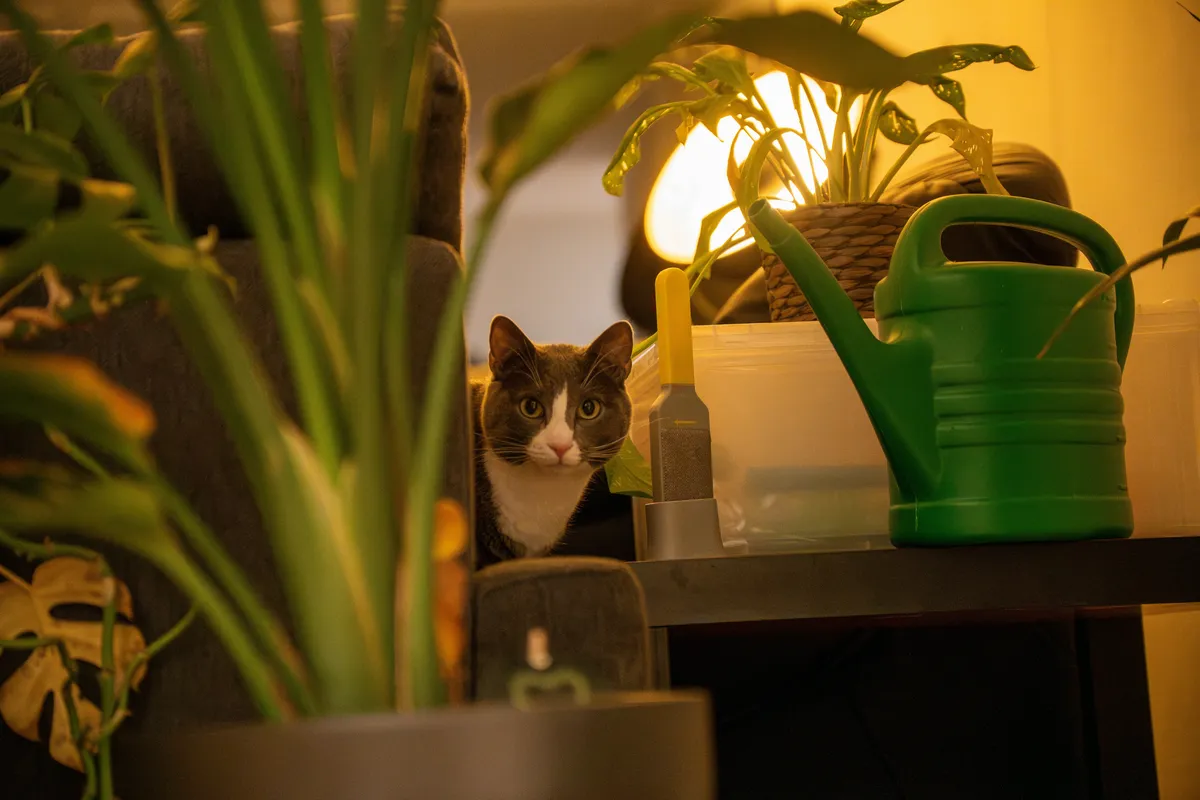
Cat-Safe Houseplants: A Plant Dad With Cats Guide
I have two cats and over forty houseplants. People hear that and assume I’m either reckless or lying. But here’s the thing - you absolutely can have both. You just need to know which plants are safe, which ones are genuinely dangerous, and how to keep everyone happy without turning your apartment into a padded room.
When we got our first cat, I panicked. I’d already invested years building my plant collection, and suddenly every Google search was telling me that half my shelf was a feline death trap. So I did what any anxious plant dad would do: I spent an entire weekend cross-referencing the ASPCA toxic plant database with my plant inventory, moving pots around at 2 AM while my wife questioned my life choices.
Turns out, the situation is a lot more nuanced than “plants bad, cats in danger.” Let me break it down.
The Truth About Cats and Plants
First, some perspective. Most cats don’t actually eat houseplants. They might bat a leaf, chew on something out of boredom, or knock a pot off a shelf for the sheer joy of destruction. But serious poisoning from houseplants is less common than the internet makes it sound.
That said, some plants really are dangerous - lilies being the big one. And “less common” isn’t the same as “impossible.” So if you have a cat who actively chomps on greenery (you know who you are, Mr. Whiskers), you need to be more careful than someone whose cat couldn’t care less about plants.
The goal isn’t to eliminate all risk. It’s to make smart choices so you’re not lying awake at night wondering if your Monstera is plotting against your cat.
The Best Cat-Safe Houseplants
These are all verified non-toxic by the ASPCA, and they’re genuinely good houseplants - not just the boring leftovers after you remove everything dangerous.
Spider Plant (Chlorophytum comosum)
The spider plant is basically the golden retriever of houseplants - friendly, easygoing, and gets along with everyone. Completely non-toxic to cats, tolerates low light, and produces baby plantlets you can propagate endlessly.
Fair warning: cats LOVE spider plants. Something about the dangling babies drives them wild. Your spider plant will be safe for your cat, but your cat may not be safe for your spider plant. Hang it high or accept that it’s now a cat toy that occasionally photosynthesizes.
Care: Bright indirect light, water when the top inch of soil is dry, and they’ll forgive almost anything.
Boston Fern (Nephrolepis exaltata)
Lush, dramatic, and completely cat-safe. Boston ferns add that “Victorian greenhouse” vibe to any room. They do want more humidity than your average houseplant, so bathrooms or kitchens are ideal spots.
My Boston fern lives on top of the fridge where the cats can’t reach it - not because it’s dangerous, but because one of my cats decided it was the perfect napping spot and crushed half the fronds.
Care: Medium indirect light, keep soil consistently moist (not soggy), and mist occasionally. They’re a bit dramatic about dry air.
Calathea (Calathea spp.)
Here’s a win - the entire Calathea family is non-toxic to cats. Calathea orbifolia, medallion, rattlesnake, white fusion - all safe. And they’re some of the most beautiful foliage plants you can grow indoors.
The catch is that Calatheas are fussy about humidity and water quality. They’re the high-maintenance friend who’s worth the effort. Use filtered water, keep humidity above 50%, and they’ll reward you with leaves that look like they were hand-painted.
Care: Medium indirect light (no direct sun), filtered water, high humidity. Check out the individual Calathea guides on this blog for specific varieties.
Parlor Palm (Chamaedorea elegans)
Want that tropical palm look without worrying about your cat? Parlor palms are your answer. They’ve been popular houseplants since the Victorian era because they tolerate low light and don’t need much fuss.
They grow slowly, which is actually a plus - you won’t be constantly repotting or pruning. A mature parlor palm in a nice pot is a statement piece that happens to be completely cat-safe.
Care: Low to medium indirect light, water when the top inch of soil dries out, and keep away from cold drafts.
Peperomia (Peperomia spp.)
The peperomia family is huge, diverse, and entirely non-toxic. Watermelon peperomia, peperomia obtusifolia, peperomia hope - all safe. They come in so many shapes and textures that you could build a whole collection just from peperomias.
They’re also compact, which makes them perfect for shelves and desks where space is tight. Most are semi-succulent, meaning they store water in their thick leaves and forgive you if you forget to water for a week.
Care: Bright indirect light, let the soil dry out between waterings, well-draining soil. Easy.
Prayer Plants (Maranta and Stromanthe)
Like their Calathea cousins, prayer plants are non-toxic and visually stunning. The way their leaves fold up at night is endlessly entertaining - my daughter calls them “sleepy plants” and checks on them every evening.
Marantas are generally easier than Calatheas, making them a great starting point if you want that tropical foliage look without the drama.
Care: Medium indirect light, keep soil lightly moist, appreciates humidity but more forgiving than Calathea.
Air Plants (Tillandsia spp.)
No soil, no pot, no problem. Air plants are non-toxic and can be displayed in ways that are naturally out of reach for most cats - mounted on walls, placed in hanging glass globes, or tucked into high shelves.
They’re great for small spaces and make fun weekend projects with kids. My son loves misting them with his own spray bottle.
Care: Soak in water for 20-30 minutes weekly, let dry completely, bright indirect light.
Herbs: Basil, Rosemary, and Thyme
Good news for the kitchen gardeners - basil, rosemary, and thyme are all cat-safe. You can grow your windowsill herb garden without worry. Cats generally aren’t interested in these anyway (the strong scents tend to repel them), but even if your cat takes a nibble, it’s not a problem.
Care: Full sun (south-facing window), keep soil moist, harvest regularly to encourage bushy growth.
Plants to Avoid (The Genuinely Dangerous Ones)
Not all toxic plants are created equal. Some cause mild irritation. Others can cause serious harm. Here are the ones I’d genuinely keep away from cats.
Lilies - The Big One
True lilies (Lilium and Hemerocallis species) are extremely dangerous to cats. We’re talking Easter lilies, tiger lilies, Asiatic lilies, and daylilies. Every part of the plant is toxic - flowers, leaves, pollen, even the water in the vase. Ingestion can cause kidney failure, and it doesn’t take much.
This is the one I’m dead serious about. If you have cats, don’t bring lilies into your home. Not even as cut flowers. Not even “just for a day.” The risk is too high and the consequences are too severe.
Pothos and Philodendron - The Complicated Ones
Here’s where it gets nuanced. Pothos (Epipremnum aureum) and philodendrons contain calcium oxalate crystals that cause oral irritation, drooling, and vomiting if chewed. They’re listed as toxic, and they genuinely can make your cat uncomfortable.
But here’s the honest truth: I still have pothos in my house. They’re on high shelves where the cats can’t reach them, and neither of my cats has ever shown interest. The calcium oxalate crystals cause immediate mouth pain, which means most cats take one bite and never try again. It’s not the same level of danger as lilies.
Am I recommending you keep pothos with cats? No. Am I saying it’s a nuanced decision based on your specific cat’s behavior and your ability to keep plants out of reach? Yes. If your cat is a determined plant chewer, skip them entirely. If your cat ignores plants and you can place them on a high shelf, use your judgment.
Sago Palm, Dieffenbachia, and Oleander
These are in the “absolutely not” category alongside lilies. Sago palms can cause liver failure. Dieffenbachia causes intense oral pain and swelling. Oleander is toxic to basically everything alive. Keep them out of a cat household entirely.
Practical Tips for the Cat-Plant Household
Even with all cat-safe plants, living with cats and plants requires some strategy. Here’s what’s worked for me.
Use Height Strategically
Cats can jump, but they can’t fly. Wall-mounted planters, tall plant stands, and hanging planters create space for plants that’s harder for cats to access. I use a lot of macrame hangers and floating shelves - they look great and keep plants above the chaos zone.
Provide Cat Grass
Sometimes cats chew on plants because they want greens. A pot of cat grass (wheatgrass) gives them a sanctioned salad bar. It’s cheap, grows fast, and redirects their attention away from your collection.
I keep a pot of cat grass on the floor near their food bowls. It gets demolished every few weeks, and I just start a new one. Two dollars and five minutes of effort saves me a lot of stress.
Citrus Deterrent
Cats generally dislike citrus scents. A few drops of lemon juice on a cotton ball placed near a plant can discourage curious noses. It’s not foolproof, but it helps. You can also try placing citrus peels on the soil surface - some cats hate it, others don’t care. Worth experimenting.
Secure Your Pots
Cats knock things over. This is not a theory; it’s a law of physics. Use heavy ceramic pots for floor plants, secure hanging planters with strong hooks, and consider adhesive museum putty for small pots on shelves. A broken pot is a mess. A broken pot with a cat walking through the shards is a vet visit.
Know the Emergency Numbers
Keep the ASPCA Animal Poison Control number handy: 888-426-4435. There’s a consultation fee, but it’s worth it for peace of mind. Also have your vet’s emergency line saved in your phone. In a real emergency, minutes matter.
The Bottom Line
You don’t have to choose between plants and cats. With a little knowledge and some common-sense precautions, they coexist just fine. Start with the safe plants listed above, skip the lilies entirely, and make smart placement choices for everything else.
My apartment is proof that a plant jungle and two cats can share the same space. The cats have never been poisoned. The plants have been knocked over, slept on, and occasionally used as a hiding spot during zoomies, but they’re alive.
That’s the real challenge of being a plant parent with cats - it’s not the toxicity. It’s the chaos. But honestly? I wouldn’t have it any other way.