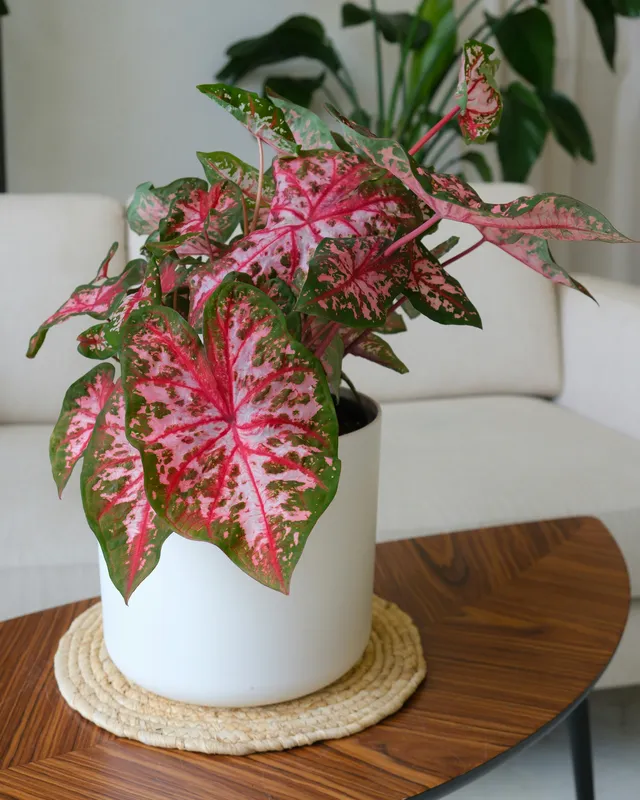
Caladium Care: Growing the Most Colorful Houseplant You Have Never Tried
If you have ever walked past a plant display and done an actual double-take, there is a good chance you were looking at a Caladium. These plants look like someone hand-painted each leaf - splashes of hot pink, bright red, creamy white, and deep green, all on these big heart-shaped canvases that seem too dramatic to be real.
Caladiums (Caladium bicolor) are tropical plants native to South America, and they have been grown as ornamental plants for over a hundred years. In parts of Southeast Asia, you will find them in gardens everywhere - my grandmother had a few growing in pots outside her apartment in Guangzhou, tucked between her jasmine and her collection of mismatched ceramic planters. I did not appreciate them then. I was too busy chasing bugs. But now, as an adult with a growing collection and a shrinking amount of windowsill space, I get it. These plants are special.
The thing about Caladiums that surprises most people is that they grow from tubers, kind of like potatoes. They sprout, put on this incredible show for months, and then they go dormant - leaves yellow, droop, and die back. If you do not know this going in, you will absolutely panic. I am here to tell you: do not panic. That is just what they do.
Let me walk you through everything you need to keep these beauties happy indoors.
Light: Bright but Gentle
Caladiums want bright, indirect light. Think of the dappled light that filters through a forest canopy - that is their sweet spot.
A spot near an east-facing window is ideal. A south or west-facing window works too, but pull the plant back a couple of feet or use a sheer curtain. Direct sun - especially harsh afternoon sun - will scorch those gorgeous thin leaves, and scorched Caladium leaves are not a good look.
Here is the light cheat sheet:
- Best: Bright indirect light near an east or north-facing window
- Fine: A few feet back from a south or west window with filtered light
- Avoid: Direct afternoon sun, which burns the thin leaves quickly
- Too little light: Leaves lose their vivid color patterns and growth slows down
One thing I have noticed is that the more light they get (indirect, remember), the more dramatic the leaf colors become. My ‘White Christmas’ Caladium near the living room window has much more vivid veining than the one I tried in the back hallway. Lesson learned.
Water: Consistent Moisture Without the Swamp
Caladiums like their soil consistently moist during the growing season. Not wet, not soggy, not standing in a puddle - just evenly moist. Think of a wrung-out sponge.
Check the top inch of soil. If it feels dry, it is time to water. During the peak of summer when they are actively growing, this might be every 3 to 4 days. In the shoulder months of spring and fall, maybe once a week.
A few watering tips that have saved me:
- Use room temperature water. Cold water shocks the tubers and can cause leaf curling.
- Water thoroughly until it drains from the bottom, then dump the saucer. No plant likes wet feet.
- Do not let the soil dry out completely. Caladiums will droop dramatically if they get too dry. They usually bounce back after a good drink, but repeated stress weakens the tuber.
- Reduce watering as leaves start to yellow in fall. The plant is heading into dormancy and does not need much.
If you are someone who tends to overwater (no judgment, we have all been there), make sure your pot has drainage holes and your soil mix is well-draining. Soggy soil plus tubers equals rot, and tuber rot is the number one way to lose a Caladium for good.
Soil: Light, Fluffy, and Well-Draining
Caladiums want soil that holds some moisture but does not stay waterlogged. A standard houseplant potting mix amended with perlite works great. I use roughly:
- 60% quality potting mix (peat or coco coir based)
- 30% perlite for drainage
- 10% orchid bark for extra aeration
You want a slightly acidic pH, somewhere between 5.5 and 6.5. Most peat-based mixes are already in that range, so you probably do not need to overthink this.
The key principle: the soil should feel light and fluffy. If you squeeze a handful and water streams out but the soil clumps together, that is about right. If it forms a dense, heavy ball, add more perlite.
Humidity: They Want the Tropical Life
Here is where things get real. Caladiums are tropical plants, and they want humidity levels between 60 and 75 percent. Your average heated or air-conditioned home sits around 30 to 50 percent, which is not enough for them to be their best selves.
Ways to boost humidity:
- Pebble tray: Fill a tray with pebbles and water, set the pot on top. As the water evaporates, it creates a little humid microclimate.
- Grouping plants: Cluster your humidity-loving plants together. They create their own little tropical zone through transpiration.
- Humidifier: Honestly the most effective option. If you are growing Caladiums, Calatheas, and ferns, a humidifier is a worthwhile investment.
- Bathroom placement: If your bathroom gets decent light, Caladiums love the steam.
My Caladiums share shelf space with my Calathea collection and a small humidifier that runs during the day. The Calatheas stopped throwing tantrums, the Caladiums put out bigger leaves, and I stopped finding crispy leaf edges everywhere. Win-win-win.
Temperature: Keep It Warm
Caladiums are not cold-hardy at all. They want temperatures between 65 and 80 degrees Fahrenheit (18 to 27 Celsius). Below 60 degrees, they start to struggle, and anything near 50 degrees can damage the tubers.
In practical terms:
- Keep them away from cold drafts, AC vents, and single-pane windows in winter.
- They are fine in normal room temperatures during the growing season.
- If you move them outdoors for summer (which they love), bring them back inside before night temperatures drop below 60 degrees.
I keep mine in the living room where the thermostat stays between 68 and 74 degrees year-round. That works perfectly.
The Big One: Dormancy
Okay, this is the part that scares people away from Caladiums, and I want to demystify it completely.
Caladiums are deciduous. They grow from tubers, and those tubers need a rest period - typically in late fall and winter. Here is what happens:
- Leaves start to yellow and droop. This usually begins in September or October, depending on your conditions.
- Do not panic. This is normal. You did not kill your plant.
- Reduce watering gradually as the leaves decline. Once all the foliage has died back, stop watering entirely.
- Cut off the dead leaves at the base once they are fully brown and dried.
- Store the pot (tuber still in soil) in a dark, warm spot. The key word is warm - between 60 and 70 degrees. A closet, a cabinet, or under a bed works fine. Do not put it in the garage if your garage gets cold.
- Wait. Dormancy typically lasts 2 to 4 months.
- In late winter or early spring, bring the pot back into the light and start watering lightly. New sprouts should appear within a few weeks.
You can also dig up the tubers, let them dry for a couple of days, and store them in dry peat moss or vermiculite in a paper bag. But honestly, I just leave mine in the pot. Less fuss, same result.
The first time I went through this cycle, I was convinced the plant was dead. I almost threw out the pot. My wife stopped me - she had grown up seeing her mother’s Caladiums do this every year in their garden back in Fujian. “Just leave it alone,” she said. She was right. Three months later, a bright pink sprout poked through the soil and I felt like a kid on Christmas morning.
Varieties Worth Growing
There are over a thousand named Caladium cultivars, which is a little overwhelming. Here are a few that do especially well indoors:
- ‘White Christmas’: White leaves with dark green veining. Stunning and one of the most shade-tolerant.
- ‘Carolyn Whorton’: Pink leaves with green speckles. A classic that is easy to find.
- ‘Red Flash’: Deep red centers with green margins. Bold and dramatic.
- ‘Florida Moonlight’: Almost entirely white with thin green edges. Ethereal.
- ‘Thai Beauty’: Compact strap-leaf variety with pink and green patterns. Great for smaller pots.
- ‘Heart to Heart Lemon Blush’: Chartreuse leaves with pink veins. Perfect if you want something different.
Strap-leaf varieties (with narrower, lance-shaped leaves) tend to be more sun-tolerant and compact, making them a bit easier for indoor growing. Fancy-leaf varieties (the big heart-shaped ones) are showier but a touch more demanding.
Common Problems and How to Fix Them
Brown, crispy leaf edges: Low humidity. Increase moisture in the air using one of the methods above.
Yellowing leaves (during growing season): Could be overwatering, underwatering, or too much direct sun. Check the soil moisture first. If the soil is soggy and smells off, you may have root rot.
Leggy, pale growth: Not enough light. Move to a brighter spot with more indirect light.
No new growth in spring: The tuber may have been stored too cold. Check that it is firm and not mushy. A healthy tuber should feel solid, like a small potato. If it is soft or has a foul smell, it has rotted and needs to be composted.
Pests: Caladiums can attract aphids, spider mites, and mealybugs, especially in dry indoor conditions. Check the undersides of leaves regularly. A spray of diluted neem oil or insecticidal soap takes care of most infestations if caught early.
Leaf spots: Brown or black spots can be fungal. Improve air circulation, avoid getting water on the leaves, and remove affected foliage.
Fertilizing: Easy Does It
During the growing season (spring through early fall), feed your Caladium every 2 to 4 weeks with a balanced liquid fertilizer diluted to half strength. A standard 10-10-10 or 20-20-20 works fine.
Do not fertilize during dormancy. The plant is sleeping. Let it sleep.
One thing to watch for: fertilizer salt buildup in the soil. If you see a white crusty layer on top of the soil, flush the pot with plain water a few times to wash out excess salts.
Are Caladiums Toxic?
Yes. Caladiums contain calcium oxalate crystals, which are toxic to humans, cats, and dogs if ingested. The crystals cause intense mouth and throat irritation, swelling, and difficulty swallowing.
If you have curious toddlers or pets that like to taste-test your plant collection, keep Caladiums up high on a shelf or in a room that is off-limits. I have mine on a high floating shelf in the living room where little hands and paws cannot reach.
Why You Should Give Caladiums a Try
I know the dormancy thing can seem intimidating. Nobody wants to watch a gorgeous plant lose all its leaves and wonder if they did something wrong. But once you go through one cycle - growth, color, dormancy, and then that magical moment when the first new sprout appears - you will be hooked.
Caladiums bring a level of color that almost no other houseplant can match. They connect me to my family’s gardening traditions in a way that feels meaningful. And every spring, when those first pink and white leaves unfurl from the soil, it feels like the plant is saying hello again after a long winter nap.
If you are looking for your next plant project, grab a Caladium tuber this spring. Give it warmth, moisture, and patience. I think you will be surprised by how rewarding these painted beauties can be.